How Cameras and IoT Help Detect Forest Fires Earlier
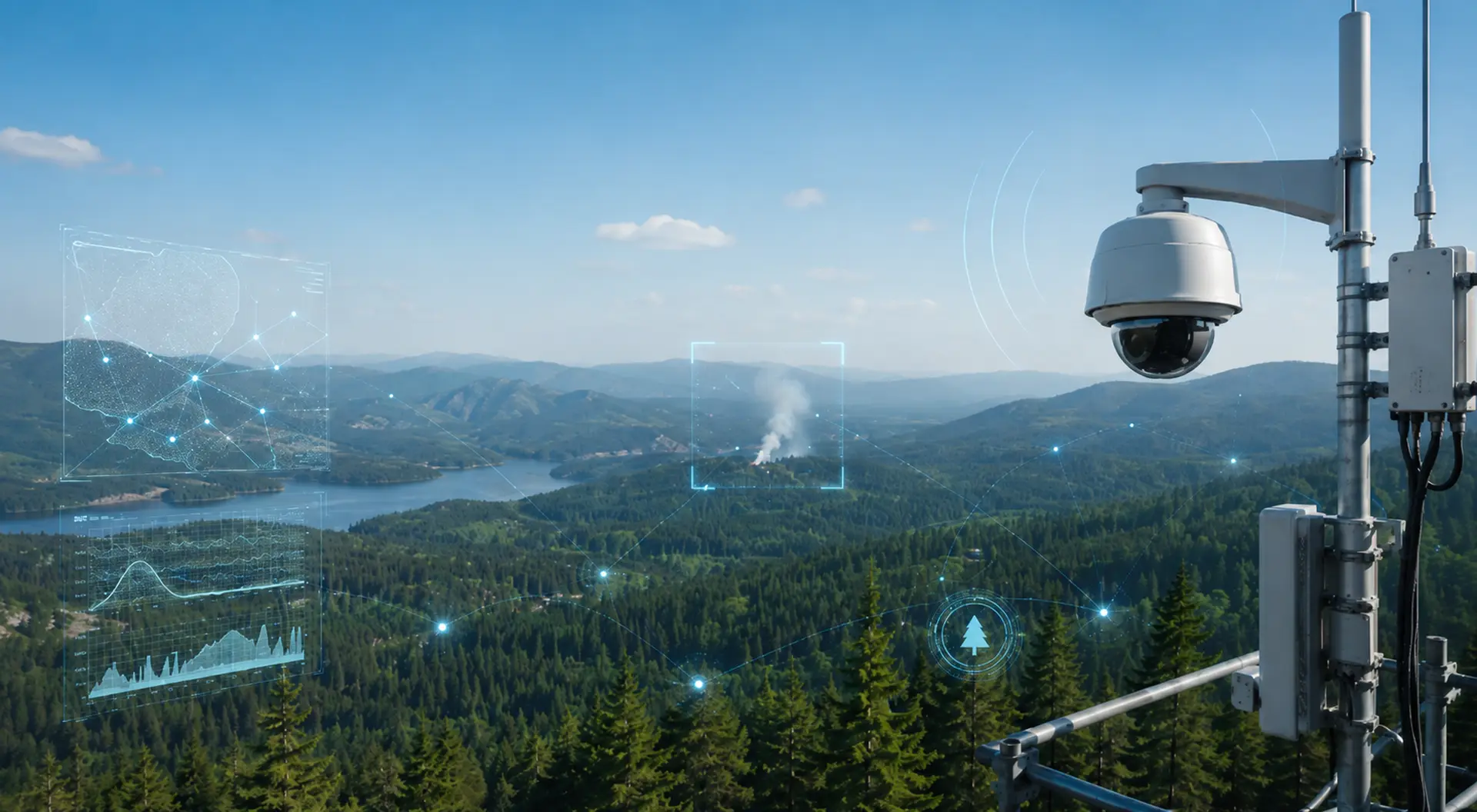
When a forest fire starts, every minute counts. Detecting a fire in its early stages can support a faster response and reduce the risk of the flames spreading.
The problem is that many fires begin in remote areas, places that are difficult to access, or locations with little human presence. That is why connected cameras, sensors, and artificial intelligence are becoming increasingly useful tools for forest fire management.
These technologies can monitor large areas continuously, identify signals such as smoke, flames, or abnormal temperature increases, and send alerts to the teams responsible for response.
How do forest monitoring cameras work?
Cameras are usually installed in elevated locations, such as towers, antennas, or mountain areas, where they can observe large areas of land.
There are different types of cameras:
Camera type | Function |
Optical cameras | Visually detect smoke or flames |
Thermal cameras | Identify temperature differences and can operate at night |
PTZ cameras | Can pan, tilt, and zoom into a specific area |
Images can be monitored from a control center or analyzed using artificial intelligence.
When the system identifies a possible smoke column or heat source, it generates an alert with the image and approximate location so an operator can check what is happening.
Artificial intelligence to detect smoke and fire
Artificial intelligence can analyze images automatically. Algorithms can identify changes in the landscape, movements that may indicate a smoke column, flames, or areas with a higher-than-usual temperature.
This makes it possible to monitor several cameras at the same time without relying only on a person watching the images continuously.
However, the technology is not infallible. Fog, clouds, dust, or steam can be confused with smoke. That is why the system usually generates an initial alert, which a professional then validates.
The role of IoT in forest fire management
For alerts to reach the teams responsible, cameras and sensors need to be connected.
IoT makes it possible to integrate different devices into the same network and send information such as:
Images and alerts
Coordinates of the possible fire source
Temperature and humidity
Wind data
Battery status
Coverage level
Device failure alerts
In this context, 1NCE enables sensors, gateways, and other IoT devices to connect from a single platform, making it easier to send alerts and monitor equipment installed across different observation points.
This allows responsible teams to monitor cameras and sensors distributed across large areas without needing to travel to check each device.
In addition, it is not always necessary to transmit video continuously. Many systems analyze images directly on the camera or gateway and only send information when they detect a possible incident.
This reduces data consumption and supports operation in areas with limited connectivity.
Connectivity in remote areas
One of the main challenges in these projects is that cameras and sensors are often installed far from WiFi networks or fiber connections.
Cellular connectivity allows devices to connect without depending on a fixed network, as long as mobile coverage is available.
The type of connectivity will depend on the volume of data that needs to be transmitted. A temperature sensor requires very little capacity, while a camera that sends images or video needs more bandwidth.
Technologies such as NB-IoT or LTE-M can be used for sensors and low-power devices. For image or video transmission, higher-capacity cellular networks may be required.
Cameras, sensors, and other technologies
It is important to note that these cameras do not replace satellites, drones, weather stations, or surveillance patrols. All these tools can work together.
Technology | Main use |
Ground cameras | Continuous monitoring of a specific area. |
IoT sensors | Measurement of temperature, humidity, or gases. |
Satellites | Observation of large areas. |
Drones | Detailed inspection of specific zones. |
Weather stations | Information about wind and environmental conditions. |
Combining different sources makes it possible to obtain a more complete view and make decisions faster.
IoT connectivity for forest monitoring
1NCE offers IoT connectivity for low-bandwidth applications in more than 170 countries.
In a forest monitoring system, this connectivity can be used to transmit data from sensors, weather stations, gateways, and other connected devices.
It also makes it possible to manage connections centrally and check device consumption and status.
Technology cannot prevent a fire from starting on its own, but it can help detect its first signs earlier. When cameras, sensors, artificial intelligence, and connectivity work together, response teams have more information and can act faster.
More for US IoT Builders
Catch the latest news for US deployments, then go deeper with the technical guides our Miami team uses to get devices certified and live.
Newsletter
