WiFi vs Cellular for IoT: Which Connectivity Option Is Right for Your Deployment?
)
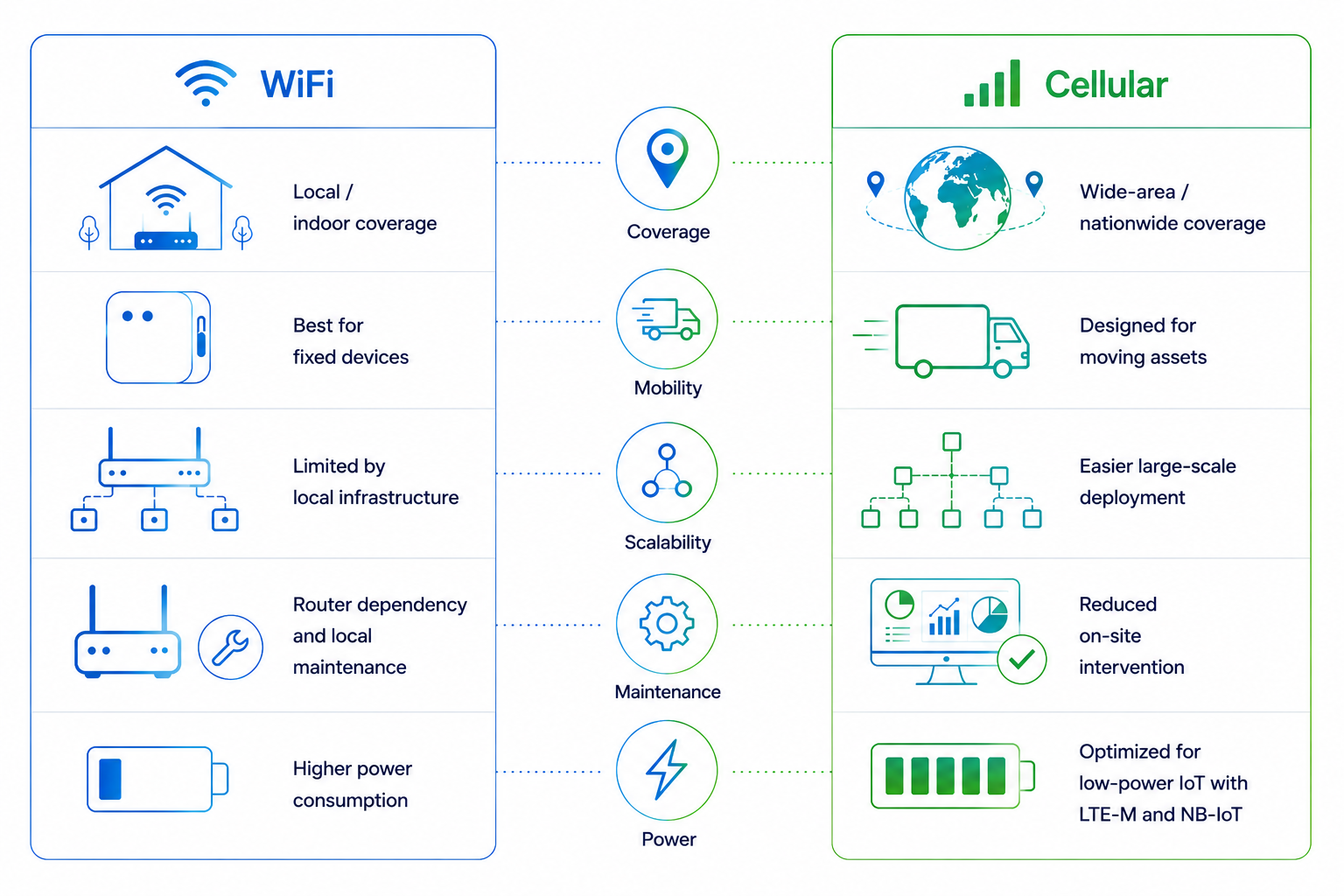
IoT connectivity is not a one-size-fits-all decision. While WiFi works well for indoor and fixed environments, Cellular IoT offers greater flexibility for remote, mobile, and large-scale deployments. Choosing the wrong connectivity option can increase maintenance costs, reduce reliability, and limit scalability over time.
So, how do you know which one is right for your IoT project?
Understanding WiFi and Cellular IoT connectivity
At a high level, WiFi connects devices using local internet infrastructure like routers and access points. Cellular IoT, on the other hand, connects devices through mobile operator networks across larger geographic areas.
Both technologies have benefits based on the deployment environment, power needs, and operational requirements.
When WiFi makes sense for IoT
WiFi can be a good choice for setups where devices stay in one place, and a reliable internet connection is already in place.
Typical WiFi IoT use cases include:
Smart home devices
Building automation
Indoor monitoring systems
Connected office equipment
Because WiFi provides relatively high bandwidth and easy setup, it is often preferred for local indoor deployments.
However, its reliance on routers and local power sources can limit its use in distributed or remote settings.
When Cellular IoT becomes the better option
Cellular connectivity is designed for deployments where coverage, mobility, and reliability are critical.
Instead of relying on local infrastructure, devices connect directly to mobile networks, enabling connectivity across cities, industrial environments, logistics operations, or remote areas.
This makes Cellular IoT particularly suitable for:
Asset tracking
Smart metering
Industrial monitoring
Fleet management
Smart city infrastructure
Technologies such as LTE-M and NB-IoT also enable lower power consumption and improved coverage for IoT deployments.
The hidden cost of IoT connectivity: maintenance
In many IoT deployments, the biggest operational challenges do not come from the devices themselves, but from connectivity management.
Battery replacements, connectivity failures, router dependency, and on-site maintenance can quickly increase operational costs, especially at scale.
This is one of the reasons why many large IoT deployments prioritize low-maintenance connectivity solutions designed specifically for IoT operations.
Platforms designed specifically for Massive IoT deployments can also simplify connectivity management at scale. For example, solutions such as 1NCE combine connectivity and cloud-native IoT software into a single platform to help reduce operational complexity and improve long-term device management.
Reliable Cellular IoT connectivity can help reduce:
Manual interventions
Maintenance visits
Downtime
Connectivity interruptions
Ultimately, improving scalability and long-term ROI.
Choosing the right connectivity for your IoT project
The right connectivity choice depends on several operational and deployment factors:
Will devices remain stationary or move frequently?
Is local infrastructure available?
How important is remote management?
What are the maintenance expectations?
How scalable does the deployment need to be?
In many IoT environments, WiFi and Cellular IoT are not competing technologies, but complementary connectivity options.
WiFi can support fixed indoor deployments where local infrastructure is already available, while Cellular IoT can add flexibility, remote coverage, and resilience for distributed or mobile devices.
As IoT ecosystems grow, many organizations adopt hybrid connectivity strategies that combine both technologies depending on operational requirements, scalability goals, and device location.
More for US IoT Builders
Catch the latest news for US deployments, then go deeper with the technical guides our Miami team uses to get devices certified and live.
Newsletter
