How Industrial IoT Is Helping Reduce Energy Bills
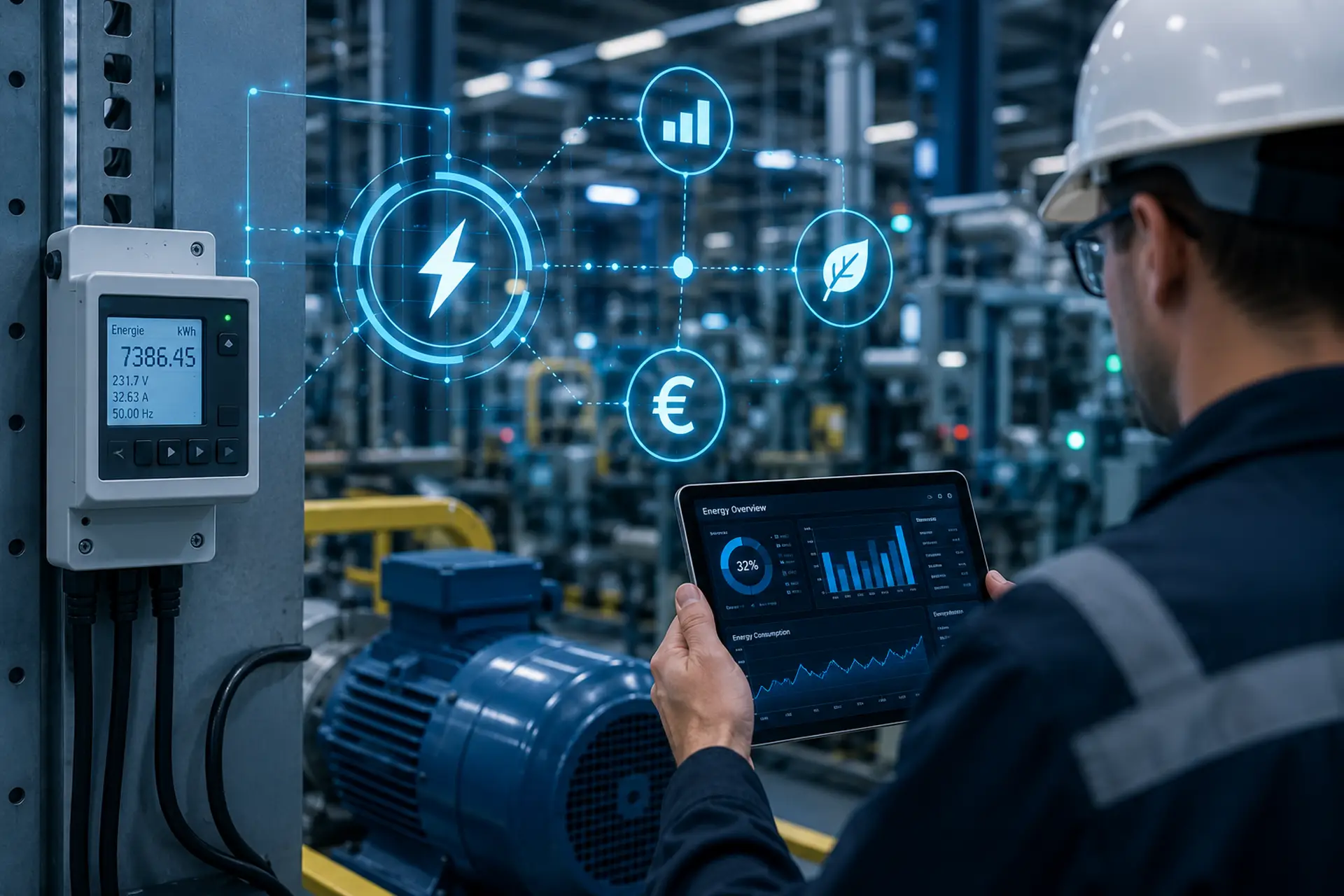
Energy costs remain one of the main pressures for industrial companies. Factories, warehouses, logistics centers, utilities, and production sites all depend on equipment that consumes power throughout the day: machines, motors, pumps, HVAC systems, refrigeration units, lighting, compressed air systems, and production lines.
When energy use is not measured in detail, waste is hard to detect.
A machine may keep consuming power while idle. A compressed air system may lose energy through leaks. A refrigeration unit may work harder than needed because of poor maintenance. A production line may create peak demand at the most expensive time of day.
Industrial IoT helps make these patterns visible.
Connected meters, sensors, and monitoring devices can collect energy data from machines, lines, buildings, and utility systems. This gives industrial teams a clearer view of where energy is used, where waste appears, and which processes need attention.
For companies working toward Industry 4.0, energy efficiency is not only a sustainability goal. It is a cost-control issue, an operations issue, and a productivity issue.
Why energy visibility matters in industrial operations
Energy bills usually arrive after the consumption has already happened. By then, teams can see the total cost, but not always the operational reason behind it.
That delay creates a problem.
If a plant consumes more energy than expected, the cause may come from many places: equipment running outside production hours, poorly maintained motors, inefficient HVAC settings, compressed air leaks, process changes, or demand peaks.
Without connected monitoring, these causes are difficult to separate.
Industrial sites need more granular data. They need to know which assets consume the most power, when demand increases, and how energy use relates to production activity.
Real-time or near real-time monitoring helps close that gap.
With connected meters and sensors, teams can track energy consumption by machine, production line, area, or facility. This makes it easier to detect unusual patterns earlier and investigate before waste becomes a recurring cost.
For companies with several plants, visibility also helps compare performance across sites. Similar equipment may consume different amounts of energy because of maintenance conditions, operating schedules, local settings, or production behavior.
How Industrial IoT supports real-time energy monitoring
Industrial IoT connects physical assets to digital monitoring systems.
In an energy efficiency project, this can include meters, sensors, gateways, and connected devices that collect data from equipment and send it to platforms where teams can analyze it.
Industrial IoT can monitor:
Data point | Why it matters |
Energy consumption | Shows how much power machines, lines, or facilities use |
Peak demand | Helps identify when energy costs are likely to increase |
Machine status | Shows whether equipment is running, idle, or stopped |
Temperature | Helps detect HVAC, refrigeration, or process inefficiencies |
Vibration | Can indicate mechanical stress or inefficient operation |
Operating hours | Helps compare usage against production output |
Compressed air usage | Can reveal leaks or unnecessary consumption |
Battery or storage status | Supports better use of stored or self-generated energy |
This type of data helps teams connect energy use with what is happening on the factory floor.
If a machine consumes power while idle, teams can investigate. If a process uses more energy during a specific shift, managers can adjust workflows. If a building consumes more energy during non-production hours, facility teams can review automation, lighting, or HVAC settings.
The value is not just measurement. It is operational context.
Where industrial energy waste usually appears
In many industrial environments, energy waste is not always obvious. It can come from small inefficiencies that repeat every day.
Industrial IoT helps detect these patterns by linking energy data with asset behavior.
Source of energy waste | How Industrial IoT helps detect it |
Machines running while idle | Tracks machine status and energy use together |
Consumption peaks | Shows when demand increases and which assets drive it |
Compressed air leaks | Detects abnormal usage patterns in air systems |
HVAC or refrigeration inefficiency | Monitors temperature, runtime, and equipment behavior |
Poor maintenance | Flags unusual vibration, heat, or power consumption |
Non-production energy use | Shows energy consumed outside operating hours |
This helps teams move from broad assumptions to targeted action.
Instead of asking the whole plant to reduce consumption, operators can identify the machines, areas, or processes that create the highest avoidable cost.
From energy data to process optimization
Energy efficiency is not only about switching off equipment. In industrial environments, energy use is closely linked to production quality, uptime, safety, and output.
That is why optimization needs context.
Industrial IoT can connect energy data with operational data. This helps teams understand whether energy is being used effectively or wasted.
For example, a motor that consumes more power than usual may be working under mechanical stress. A refrigeration system that runs continuously may need maintenance. A production line that uses energy during idle periods may need better scheduling. A compressed air system with abnormal consumption may indicate leakage.
These are not only energy issues. They are operational issues.
With connected monitoring, companies can identify where energy waste is linked to maintenance, equipment behavior, process design, or production planning.
This supports more focused decisions. Teams can prioritize the assets that create the highest cost and avoid unnecessary changes in areas that are already performing well.
Industry 4.0 as a driver of energy efficiency
Industry 4.0 is often associated with automation, connected machines, and digital production systems. But it also has a direct role in energy efficiency.
A connected industrial site can measure consumption more accurately, compare performance across lines, and use data to improve decision-making.
This can support:
Energy benchmarking between plants
More efficient production scheduling
Faster detection of equipment inefficiencies
Better maintenance planning
Lower idle-time consumption
More accurate use of renewable energy or storage
Improved reporting for sustainability and cost-control goals
For companies operating several plants, the value increases.
A single facility may identify local energy savings. But a multi-site operation can compare patterns across locations, replicate improvements, and standardize better practices.
This is where Industrial IoT becomes a practical tool for expanding efficiency projects beyond one pilot plant.
Connectivity as the base of multi-site energy monitoring
Energy monitoring depends on connected devices. If meters and sensors cannot transmit data reliably, teams only get a partial view of consumption.
This is especially important when companies operate across several plants, warehouses, or distributed industrial sites.
Some devices may be installed in areas where fixed networks are not available. Others may need to run for long periods with limited maintenance. Some may send only small amounts of data, while others may need more frequent transmission depending on the use case.
Cellular IoT can support these deployments by allowing devices to connect without relying on local routers or site-specific network infrastructure.
Technologies such as NB-IoT and LTE-M are relevant for low-power devices that send small amounts of data over long periods. They can be useful for meters, sensors, monitoring devices, and other energy efficiency applications.
For industrial companies, the right connectivity setup can reduce installation work and make it easier to extend energy monitoring across more locations.
How 1NCE supports energy efficiency projects at scale
Energy efficiency projects often start with a focused use case: one production line, one facility, or one equipment category. But the real value appears when the model can expand across multiple plants and assets.
That expansion depends on connectivity that is easy to deploy and manage.
1NCE provides IoT software and connectivity for connected products across 170+ countries. Its platform supports 40+ million connected products and more than 30,000 customers across industries.
For industrial energy monitoring, 1NCE can support connected meters, sensors, and monitoring devices across different plants, warehouses, and operational environments.
The value is practical. Companies can connect devices, monitor them over time, and reduce the work involved in managing distributed IoT deployments.
1NCE OS also includes features such as Whereabouts, which supports cell-tower-based positioning without GPS hardware, and Energy Saver, which helps optimize battery use depending on the use case. These capabilities can be useful for energy monitoring devices deployed across large sites or locations where maintenance access is limited.
For companies looking to expand energy efficiency projects across several facilities, connectivity becomes part of the business case. Devices need to keep sending data reliably so teams can compare, optimize, and act.
A practical path to lower energy waste
Industrial IoT will not reduce energy bills by itself. Companies still need the right operational processes, maintenance actions, and management decisions.
But IoT provides the data foundation.
With connected energy monitoring, industrial teams can identify where consumption is higher than expected, detect inefficient equipment earlier, and optimize processes based on real operating conditions.
For Industry 4.0 projects, this makes energy efficiency more measurable and easier to manage.
The result is not only lower energy waste. It is better visibility into how industrial operations consume power, where improvements are possible, and how those improvements can be expanded across multiple sites.
More for US IoT Builders
Catch the latest news for US deployments, then go deeper with the technical guides our Miami team uses to get devices certified and live.
Newsletter
